Sunday, December 04, 2005

Broadcasting TV systems
SECAM
SECAM (Sequentiel Couleur avec Mémoire, French for "sequential color with memory") is an analog television system, using frequency modulation to encode chrominance information. It is so named because it uses memory to store lines of color information, in order to eliminate the color artifacts found on systems using the NTSC standard.
It was developed for the same purpose as PAL, but uses a different (and many would argue inferior) mechanism to do so. R-Y and B-Y information is transmitted in alternate lines, and a video line store is used to combine the signals together. This means that the vertical colour resolution is halved relative to PAL and NTSC.
SECAM was introduced in France in 1967, where it is still used; it has also been adopted in many former French colonies, as well as parts of Eastern Europe (Bulgaria, Hungary) and the former Soviet Union. Many have argued that the primary motivation for the development of SECAM in France was to protect French television equipment manufacturers and make it more difficult to view non-French programming.
Political factors from the Cold War have also been attributed to the adoption of SECAM in Eastern Europe, as its use made it impossible for most Eastern Europeans to view television which was broadcast from outside the Iron Curtain which were mostly using PAL.
There are three varieties of SECAM:
1. French SECAM is used in France and its former colonies
2. MESECAM is used in the Middle East
3. D-SECAM is used in the Commonwealth of Independent States and Eastern Europe.
NTSC
The National Television Standards Committee sets the analog television standard for the United States; this format itself is also informally called "NTSC".
While a standard for the United States, it has been adopted in other countries as well, for example Japan. The current version replaced an older NTSC standard by adding chrominance information on a 3.579545 (exactly 315/88) MHz subcarrier, retaining compatibility with older black-and-white NTSC television receivers.
The NTSC format consists of 29.97 interlaced frames of video a second, each consisting of 480 lines of vertical resolution out of a total of 525 (the rest are used for sync, vertical retrace, and other data such as captioning).
NTSC interlaces its scanlines, drawing odd-numbered scanlines in odd-numbered fields and even-numbered scanlines in even-numbered fields, which gives a nearly flicker-free image at approximately 59.94 hertz (nominally 60 Hz / 1.001) refresh frequency, which is close to the nominal 60 Hz alternating current power used in the United States. (Compare this to the 50 Hz refresh rate of the 625-line PAL video format used in Europe, where 50 Hz (25 hertz is resonant) AC is the standard; PAL has noticeably more flicker than NTSC.) Synchronization of the refresh rate to the power cycle helped film cameras record early live television broadcasts, as it was very simple to sync a film projector to capture a frame of video to a film cell using the frequency of the alternating current.
Also, it was preferable to match the screen refresh rate to the power source so as to avoid wave interference that would produce rolling bars on the screen.
PAL
PAL, short for Phase Alternating Line, is the analogue video format used in television transmission in most of Europe (except France, Bulgaria, Russia, Yugoslavia, and some other countries in Eastern Europe, where SECAM is used), Australia and some Asian, African, and South American countries.
PAL was developed in Germany by Walter Bruch, and first introduced in 1967. The name "Phase Alternating Line" describes the way that part of the color information on the video signal is reversed in phase with each line, which automatically corrects phase errors in the transmission of the signal. NTSC receivers have a tint or hue control to perform the correction manually.
Some engineers jokingly expand NTSC to "Never Twice the Same Colour" while referring to PAL as "Perfect At Last" or "Peace At Last"! However, the alternation of colour information - Hanover bars - can lead to picture grain on pictures with extreme phase errors.
The PAL colour system is usually used with a video format that has 625 lines per frame and a refresh rate of 25 frames per second. Like NTSC this is an interlaced format. Each frame consists of two fields (half-a-frame), each field has half of the lines of a frame (one has all the even lines, one has all the odd lines). Fields are transmitted and displayed successively. There are 50 fields per second. At the time of its design, the interlacing of fields was a compromise between flicker and bandwidth.
DENC
DENC means Digital Encoder. In order to display digital video on analog TVs the video signal must be encoded in standards such as PAL, NTSC or SECAM. This operation is performed by a DENC hardware device.
Friday, December 02, 2005
What is DVB?
DVB (Digital Video Broadcast) is a set of standards for the digital transmission of video and audio streams, and also data transmission.
The DVB standards are maintained by the DVB Project, which is an industry-led consortium of over 260 broadcasters, manufacturers, network operators, software developers, regulatory bodies and others in over 35 countries.
DVB standards are available on the web at the ETSI Publications Download Area.
DVB has been implemented over satellite (DVB-S, DVB-S2), cable (DVB-C), terrestrial broadcasting (DVB-T), and handheld terminals (DVB-H).
DVB utilizes MPEG-2 compression.
DVB primarily uses Musicam audio encoding, but also has optional support for AC3.
The DVB standards are maintained by the DVB Project, which is an industry-led consortium of over 260 broadcasters, manufacturers, network operators, software developers, regulatory bodies and others in over 35 countries.
DVB standards are available on the web at the ETSI Publications Download Area.
DVB has been implemented over satellite (DVB-S, DVB-S2), cable (DVB-C), terrestrial broadcasting (DVB-T), and handheld terminals (DVB-H).
DVB utilizes MPEG-2 compression.
DVB primarily uses Musicam audio encoding, but also has optional support for AC3.
What is Reed-Solomon?
Reed-Solomon is an algorithm for Forward Error Correction (FEC).
Reed-Solomon was introduced by Irving S. Reed and Gustave Solomon of MIT Labs in Polynomial Codes Over Certain Finite Fields, which was published in the Journal of the Society for Industrial and Applied Mathematics in 1960.
Reed-Solomon does not specify a block size or a specific number of check symbols. These variables can be set to the best variables for each transmission medium.
DVB uses Reed Solomon coding configured to use blocks of 188 information symbols and 16 check symbols, which results in a total block size of 204 symbols.
Reed-Solomon is often abbreviated as RS.
Reed-Solomon was introduced by Irving S. Reed and Gustave Solomon of MIT Labs in Polynomial Codes Over Certain Finite Fields, which was published in the Journal of the Society for Industrial and Applied Mathematics in 1960.
Reed-Solomon does not specify a block size or a specific number of check symbols. These variables can be set to the best variables for each transmission medium.
DVB uses Reed Solomon coding configured to use blocks of 188 information symbols and 16 check symbols, which results in a total block size of 204 symbols.
Reed-Solomon is often abbreviated as RS.
What is Forward Error Correction (FEC)?
Forward Error Correction (FEC) is a type of error correction which improves on simple error detection schemes by enabling the receiver to correct errors once they are detected. This reduces the need for retransmissions.
FEC works by adding check bits to the outgoing data stream. Adding more check bits reduces the amount of available bandwidth, but also enables the receiver to correct for more errors.
Forward Error Correction is particulary well suited for satellite transmissions, where bandwidth is reasonable but latency is significant.
Forward Error Correction vs. Backward Error Correction
Forward Error Correction protocols impose a greater bandwidth overhead than backward error correction protocols, but are able to recover from errors more quickly and with significantly fewer retransmissions.
FEC works by adding check bits to the outgoing data stream. Adding more check bits reduces the amount of available bandwidth, but also enables the receiver to correct for more errors.
Forward Error Correction is particulary well suited for satellite transmissions, where bandwidth is reasonable but latency is significant.
Forward Error Correction vs. Backward Error Correction
Forward Error Correction protocols impose a greater bandwidth overhead than backward error correction protocols, but are able to recover from errors more quickly and with significantly fewer retransmissions.
What is 8PSK?
8PSK (8 Phase Shift Keying) is a phase modulation algorithm.
Phase modulation is a version of frequency modulation where the phase of the carrier wave is modulated to encode bits of digital information in each phase change.
The "PSK" in 8PSK refers to the use of Phased Shift Keying. Phased Shift Keying is a form of phase modulation which is accomplished by the use of a discrete number of states. 8PSK refers to PSK with 8 sates. With half that number of states, you will have QPSK. With twice the number of states as 8PSK, you will have 16PSK.
Because QPSK has 8 possible states 8PSK is able to encode three bits per symbol.
8PSK is less tolerant of link degradation than QPSK, but provides more data capacity.
Phase modulation is a version of frequency modulation where the phase of the carrier wave is modulated to encode bits of digital information in each phase change.
The "PSK" in 8PSK refers to the use of Phased Shift Keying. Phased Shift Keying is a form of phase modulation which is accomplished by the use of a discrete number of states. 8PSK refers to PSK with 8 sates. With half that number of states, you will have QPSK. With twice the number of states as 8PSK, you will have 16PSK.
Because QPSK has 8 possible states 8PSK is able to encode three bits per symbol.
8PSK is less tolerant of link degradation than QPSK, but provides more data capacity.
What is QPSK?
QPSK (Quadrature Phase Shift Keying) is a phase modulation algorithm.
Phase modulation is a version of frequency modulation where the phase of the carrier wave is modulated to encode bits of digital information in each phase change.
The "PSK" in QPSK refers to the use of Phased Shift Keying. Phased Shift Keying is a form of phase modulation which is accomplished by the use of a discrete number of states. QPSK refers to PSK with 4 states. With half that number of states, you will have BPSK (Binary Phased Shift Keying). With twice the number of states as QPSK, you will have 8PSK.
The "Quad" in QPSK refers to four phases in which a carrier is sent in QPSK: 45, 135, 225, and 315 degrees.
QPSK Encoding
Because QPSK has 4 possible states, QPSK is able to encode two bits per symbol.
QPSK is more tolerant of link degradation than 8PSK, but does not provide as much data capacity.
Phase modulation is a version of frequency modulation where the phase of the carrier wave is modulated to encode bits of digital information in each phase change.
The "PSK" in QPSK refers to the use of Phased Shift Keying. Phased Shift Keying is a form of phase modulation which is accomplished by the use of a discrete number of states. QPSK refers to PSK with 4 states. With half that number of states, you will have BPSK (Binary Phased Shift Keying). With twice the number of states as QPSK, you will have 8PSK.
The "Quad" in QPSK refers to four phases in which a carrier is sent in QPSK: 45, 135, 225, and 315 degrees.
QPSK Encoding
Because QPSK has 4 possible states, QPSK is able to encode two bits per symbol.
Phase                Data
45  degrees       Binary 00
135 degrees       Binary 01
225 degrees       Binary 11
315 degrees       Binary 10
QPSK is more tolerant of link degradation than 8PSK, but does not provide as much data capacity.
What is symbol rate?
The symbol rate is the rate of state changes on a communications circuit.
If a circuit can carry two tones per second, the circuit has a symbol rate of two.
Circuits then use different modulation techniques to carry multiple bits per symbol.
If the circuit is limited to two different tones, the first tone can represent a 0 and the second tone can represent a 1. In this circuit, the symbol rate is the same as the bit rate.
If the circuit can carry four different tones, then the tones can be used to encode twice as many bits per symbol. In this circuit, the bit rate is now twice the symbol rate.
Using more tones allows more bits per second (bps) to be squeezed out of every symbol, but this also requires higher quality circuits. If the circuit is not high enough quality, the number of retransmissions will cause the circuit to be slower than with a lower number of tones.
The choice of how many tones to use is determined by the modulation algorithm chosen. QPSK uses four tones, 8PSK uses eight tones.
The use of 4 tones is standard in the satellite world. In the cable television world, the higher quality transmission medium enables 64 tones to be the standard, using 64QAM modulation.
Symbol Rate is abbreviated as SR.
The symbol rate is also known as the baud rate.
If a circuit can carry two tones per second, the circuit has a symbol rate of two.
Circuits then use different modulation techniques to carry multiple bits per symbol.
If the circuit is limited to two different tones, the first tone can represent a 0 and the second tone can represent a 1. In this circuit, the symbol rate is the same as the bit rate.
If the circuit can carry four different tones, then the tones can be used to encode twice as many bits per symbol. In this circuit, the bit rate is now twice the symbol rate.
Using more tones allows more bits per second (bps) to be squeezed out of every symbol, but this also requires higher quality circuits. If the circuit is not high enough quality, the number of retransmissions will cause the circuit to be slower than with a lower number of tones.
The choice of how many tones to use is determined by the modulation algorithm chosen. QPSK uses four tones, 8PSK uses eight tones.
The use of 4 tones is standard in the satellite world. In the cable television world, the higher quality transmission medium enables 64 tones to be the standard, using 64QAM modulation.
Symbol Rate is abbreviated as SR.
The symbol rate is also known as the baud rate.
What is azimuth?
What is azimuth?
Azimuth is fancy name for direction.
Azimuth is an angular measurement made in the horizontal plane.
A correct azimuth setting is critical pointing a satellite antenna.
Magnetic compass North will vary from the true azimuth North by the value of declination.
Azimuth is fancy name for direction.
Azimuth is an angular measurement made in the horizontal plane.
A correct azimuth setting is critical pointing a satellite antenna.
Magnetic compass North will vary from the true azimuth North by the value of declination.
What is elevation?
Elevation is the angular measurement of a satellite above the horizon.
Elevation is mesured in degrees. A satellite which is higher in the sky will have a greater elevation than one which is close to the horizon.
A satellite exactly level with the horizon would have an elevation of 0 degrees. A satellite with an elevation of 90 degrees would be directly overhead.
Knowing the elevation of a satellite from your location is critical to being able to successfully point a satellite antenna to it.
Elevation is mesured in degrees. A satellite which is higher in the sky will have a greater elevation than one which is close to the horizon.
A satellite exactly level with the horizon would have an elevation of 0 degrees. A satellite with an elevation of 90 degrees would be directly overhead.
Knowing the elevation of a satellite from your location is critical to being able to successfully point a satellite antenna to it.
What is uplink? downlink?
Thursday, December 01, 2005
What is an LNB?
LNB - Low Noise Block
An LNB, or Low Noise Block, is an amplifier which receives the radio signal from the satellite after it has been reflected by the satellite dish.
In addition to amplifying the signal, the LNB also converts the signal to a frequency usable by the In-Door-Unit.
The functions of the LNB were at one time provided by two separate components, a Low Noise Amplifier (LNA) for signal amplification and a block downconverter for downconversion.
Most LNB's used for satellite television include an integrated feedhorn. An LNB with an integrated feedhorn is known an an LNBF.
C Band LNB's are measured in degrees Kelvin, with a lower number representing a higher grade LNB. Ku and Ka band LNB's are measured in decibels, with a lower number also representing a higher quality LNB.
Dual and Quad LNB Units
A Dual LNB will allow you tune into two separate satellite signals at once. This is very useful if you have two television sets and wish to watch different channels on each of them. Quad-LNB's also exist for those with more than two television sets.
What is a feedhorn?
The feedhorn is the part of a satellite dish system which gathers the reflected signal from the dish and focuses it towards the LNB.
An LNB with an integrated feedhorn is referred to an an LNBF.
--------------------------------------------------------------------------------------
C Band
C band is the original frequency allocation for communications satellites.
C-Band uses 3.7-4.2Ghz for downlink and 5.925-6.425Ghz for uplink.
The lower frequencies used by C band perform better under adverse weather conditions than the Ku band or Ka band frequencies.
C Band Dishes
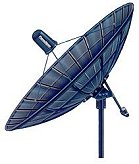
C band requires the use of a large dish, usually 6' across. C band dishes vary between 3' and 9' across, depending upon signal strength.
Because C Band dishes are so much larger than Ku and Ka band dishes, a C Band dish is sometimes referred to in friendly jest as a BUD (Big Ugly Dish).
--------------------------------------------------------------------------------------
Ku band
The Ku band uplink uses frequencies from 14 to 14.5GHz and the downlink uses frequencies between 11.7 and 12.7GHz.
The Ku band downlink frequencies are further subdivided according to their assigned use:
Ku band satellites typically transmit with much more power than C band satellites. This allows Ku band dishes to be smaller and helps Ku band transmissions to overcome rainfade.
Ku Band Dishes
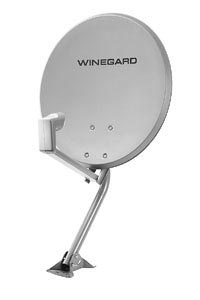
Ku band dishes can be much smaller than C band dishes. Ku band dishes vary from 2' to 5' in diameter.
Using a C Band Antenna for Ku Band
It is possible to add a Ku Band LNB to a C Band satellite dish.
For this to work properly, the C Band dish must be a solid dish or a mesh dish with holes less than one-quarter inch across.

--------------------------------------------------------------------------------------
Ka band
The Ka band uplink uses frequencies between 27.5Ghz and 31Ghz and the downlink uses frequencies between 18.3 and 18.8Ghz and between 19.7 and 20.2Ghz.
Ka band dishes can be much smaller than C band dishes. Ka band dishes vary from 2' to 5' in diameter.
Ka band satellites typically transmit with much more power than C band satellites.
The higher frequencies of Ka band are significantly more vulnerable to signal quality problems caused by rainfall, known as rainfade

--------------------------------------------------------------------------------------
An LNB, or Low Noise Block, is an amplifier which receives the radio signal from the satellite after it has been reflected by the satellite dish.
In addition to amplifying the signal, the LNB also converts the signal to a frequency usable by the In-Door-Unit.
The functions of the LNB were at one time provided by two separate components, a Low Noise Amplifier (LNA) for signal amplification and a block downconverter for downconversion.
Most LNB's used for satellite television include an integrated feedhorn. An LNB with an integrated feedhorn is known an an LNBF.
C Band LNB's are measured in degrees Kelvin, with a lower number representing a higher grade LNB. Ku and Ka band LNB's are measured in decibels, with a lower number also representing a higher quality LNB.
Dual and Quad LNB Units
A Dual LNB will allow you tune into two separate satellite signals at once. This is very useful if you have two television sets and wish to watch different channels on each of them. Quad-LNB's also exist for those with more than two television sets.
What is a feedhorn?
The feedhorn is the part of a satellite dish system which gathers the reflected signal from the dish and focuses it towards the LNB.
An LNB with an integrated feedhorn is referred to an an LNBF.
--------------------------------------------------------------------------------------
C Band
C band is the original frequency allocation for communications satellites.
C-Band uses 3.7-4.2Ghz for downlink and 5.925-6.425Ghz for uplink.
The lower frequencies used by C band perform better under adverse weather conditions than the Ku band or Ka band frequencies.
C Band Dishes
C band requires the use of a large dish, usually 6' across. C band dishes vary between 3' and 9' across, depending upon signal strength.
Because C Band dishes are so much larger than Ku and Ka band dishes, a C Band dish is sometimes referred to in friendly jest as a BUD (Big Ugly Dish).
--------------------------------------------------------------------------------------
Ku band
The Ku band uplink uses frequencies from 14 to 14.5GHz and the downlink uses frequencies between 11.7 and 12.7GHz.
The Ku band downlink frequencies are further subdivided according to their assigned use:
Ku Band Usage                   Downlink
Fixed Satellite Service         11.7 - 12.2Ghz
Broadcast Satellite Service     12.2 - 12.7Ghz
The higher frequencies of Ku band are significantly more vulnerable to signal quality problems caused by rainfall, known as rainfade, than C band satellite frequencies. However, they are less susceptible to rainfade than the Ka band frequencies.
Ku band satellites typically transmit with much more power than C band satellites. This allows Ku band dishes to be smaller and helps Ku band transmissions to overcome rainfade.
Ku Band Dishes
Ku band dishes can be much smaller than C band dishes. Ku band dishes vary from 2' to 5' in diameter.
Using a C Band Antenna for Ku Band
It is possible to add a Ku Band LNB to a C Band satellite dish.
For this to work properly, the C Band dish must be a solid dish or a mesh dish with holes less than one-quarter inch across.
--------------------------------------------------------------------------------------
Ka band
The Ka band uplink uses frequencies between 27.5Ghz and 31Ghz and the downlink uses frequencies between 18.3 and 18.8Ghz and between 19.7 and 20.2Ghz.
Ka band dishes can be much smaller than C band dishes. Ka band dishes vary from 2' to 5' in diameter.
Ka band satellites typically transmit with much more power than C band satellites.
The higher frequencies of Ka band are significantly more vulnerable to signal quality problems caused by rainfall, known as rainfade

--------------------------------------------------------------------------------------
How can we calculate the actual size of MPEG file which will be crated?
If you choose CBR, The following equation can be used to calculate. "2048/2018" stands for bitrate of system stream.
Filesize (Kb) = (Video+Audio) x (2048/2018) x sec/8
E.g. Video is 1150Kbps, audio is 224Kbps, 15 sec MPEG file would be "(1150+224) x (2048/2018) x 15/8" = 2614KB
Filesize (Kb) = (Video+Audio) x (2048/2018) x sec/8
E.g. Video is 1150Kbps, audio is 224Kbps, 15 sec MPEG file would be "(1150+224) x (2048/2018) x 15/8" = 2614KB
What is bitrate?
Bitrate means the number of bit which go through the stream per 1 sec. Stream means the MPEG file.
Generally, compression is described by bitrate in MPEG. The higher bitrate, the higher quality and lower compression, larger file size.
If the bitrate is same at any part on a single stream, it is called as CBR (Constant Bit Rate). In VBR(Variable Bit Rate), the bitrate can be different depends on the part of stream.
Generally, compression is described by bitrate in MPEG. The higher bitrate, the higher quality and lower compression, larger file size.
If the bitrate is same at any part on a single stream, it is called as CBR (Constant Bit Rate). In VBR(Variable Bit Rate), the bitrate can be different depends on the part of stream.
What is I picture P, B picture?
I picture This is independent picture which completes compression inside frame. The frame data can be played independently.
P picture This refers to previous I, P picture to extract difference, then compressed The compression is higher than I picture.
B picture This refers to both previous and next I, P picture to extract difference, then compressed The compression is higher than P picture.
P picture This refers to previous I, P picture to extract difference, then compressed The compression is higher than I picture.
B picture This refers to both previous and next I, P picture to extract difference, then compressed The compression is higher than P picture.
What type of MPEG stream is available?
MPEG-Video stream This is video part stream. The file extension would be m1v, m2v, mpv, vbs etc.
MPEG-Audio stream This is audio part stream. The file extension would be mp1, mp2, mp3, mpa, abs etc.
MPEG-System stream This is multiplex of MPEG-Video stream and MPEG-Audio stream in one stream. The file extension is mpg, m2p etc.
MPEG-Audio stream This is audio part stream. The file extension would be mp1, mp2, mp3, mpa, abs etc.
MPEG-System stream This is multiplex of MPEG-Video stream and MPEG-Audio stream in one stream. The file extension is mpg, m2p etc.
How will get 0x12 from 0x1234?
Just do Right Shift 8 times. Thats it.
But Normally we say that & with 0xFF00 and do right shift 8 times. Please remember to think before answering what is the question and the possibilities to reduce instructions/ execution time/ memory consumptioin.
Simple Example, If we want to multiply a value by 2, we put
"value * 2"
But efficient way would be
"Value << 1"
That is left shift one time will give multiples of two. This will reduce the CPU cycles consumed.
Left Shift is faster than Multiplication
But Normally we say that & with 0xFF00 and do right shift 8 times. Please remember to think before answering what is the question and the possibilities to reduce instructions/ execution time/ memory consumptioin.
Simple Example, If we want to multiply a value by 2, we put
"value * 2"
But efficient way would be
"Value << 1"
That is left shift one time will give multiples of two. This will reduce the CPU cycles consumed.
Left Shift is faster than Multiplication
What is the Size of Class having a "int" variable and a inline function?
The size of that class is only the size of that int variable. sizeof dont consider the size of Inline functions.
Consider size of the word is 4 bytes. So, sizeof( A ) will return 4 bytes only.
Example:

Class A
{
    int IntVariable;
    void PrintContent( void )
    {
        cout << endl << IntVariable << endl;
    };
}
Consider size of the word is 4 bytes. So, sizeof( A ) will return 4 bytes only.
Is It possible to call a Static function by a Function Pointer?
Yes It is Possible. Eventhough, static functions are local to that file, if we assign that function address to a same type (prototype should be strictly same, otherwise result unknown) function pointer. We can call that function indirectly...
Subscribe to:
Posts (Atom)